Craft Commerce
E-Commerce That Doesn't Make You Compromise
Shopify is fast to set up and impossible to customize. Magento is infinitely customizable and impossible to maintain. WooCommerce is a blogging platform pretending to be a store. You've probably tried at least one of these and hit the wall where your business requirements exceeded what the platform could do without ugly workarounds.
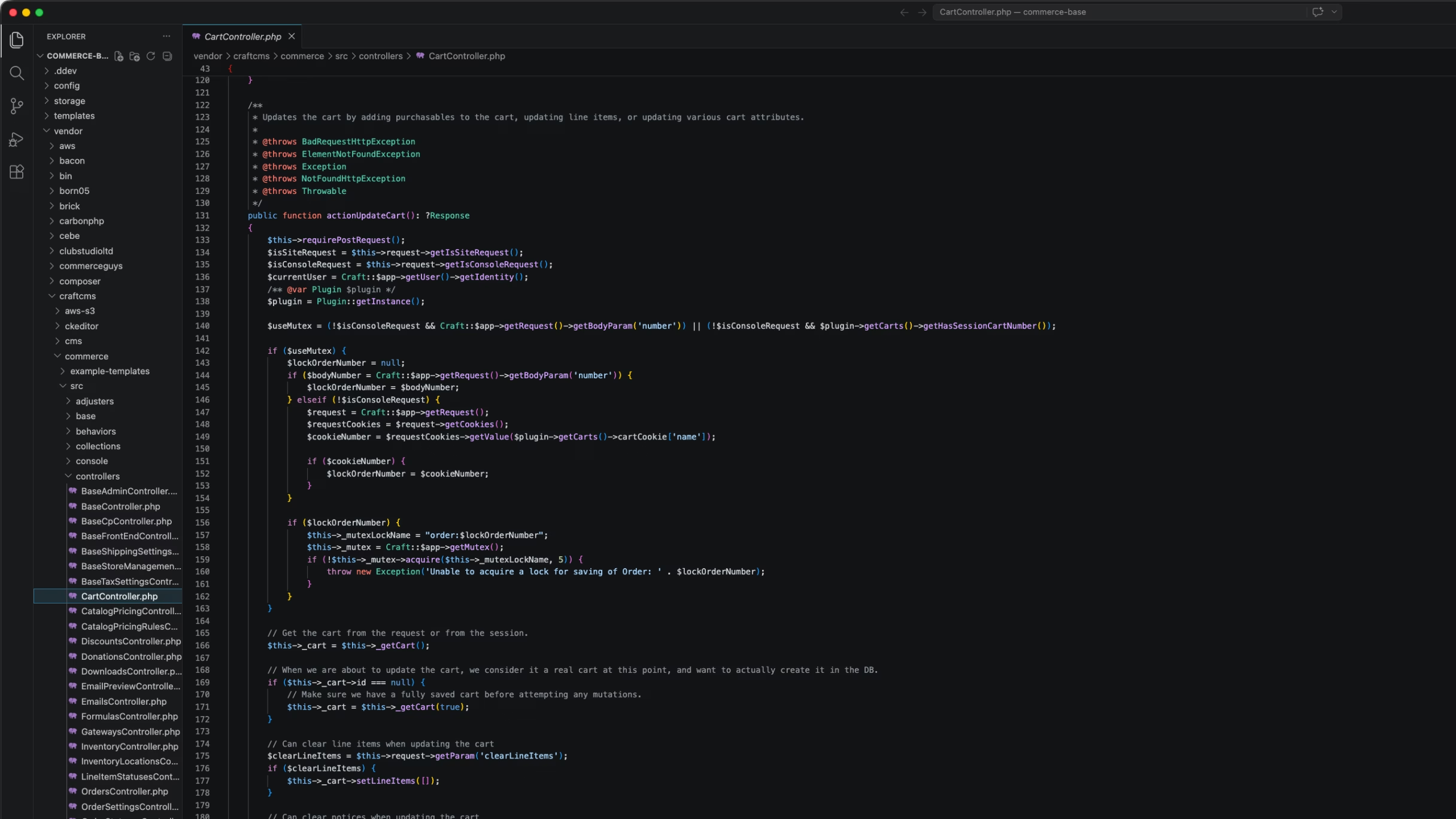
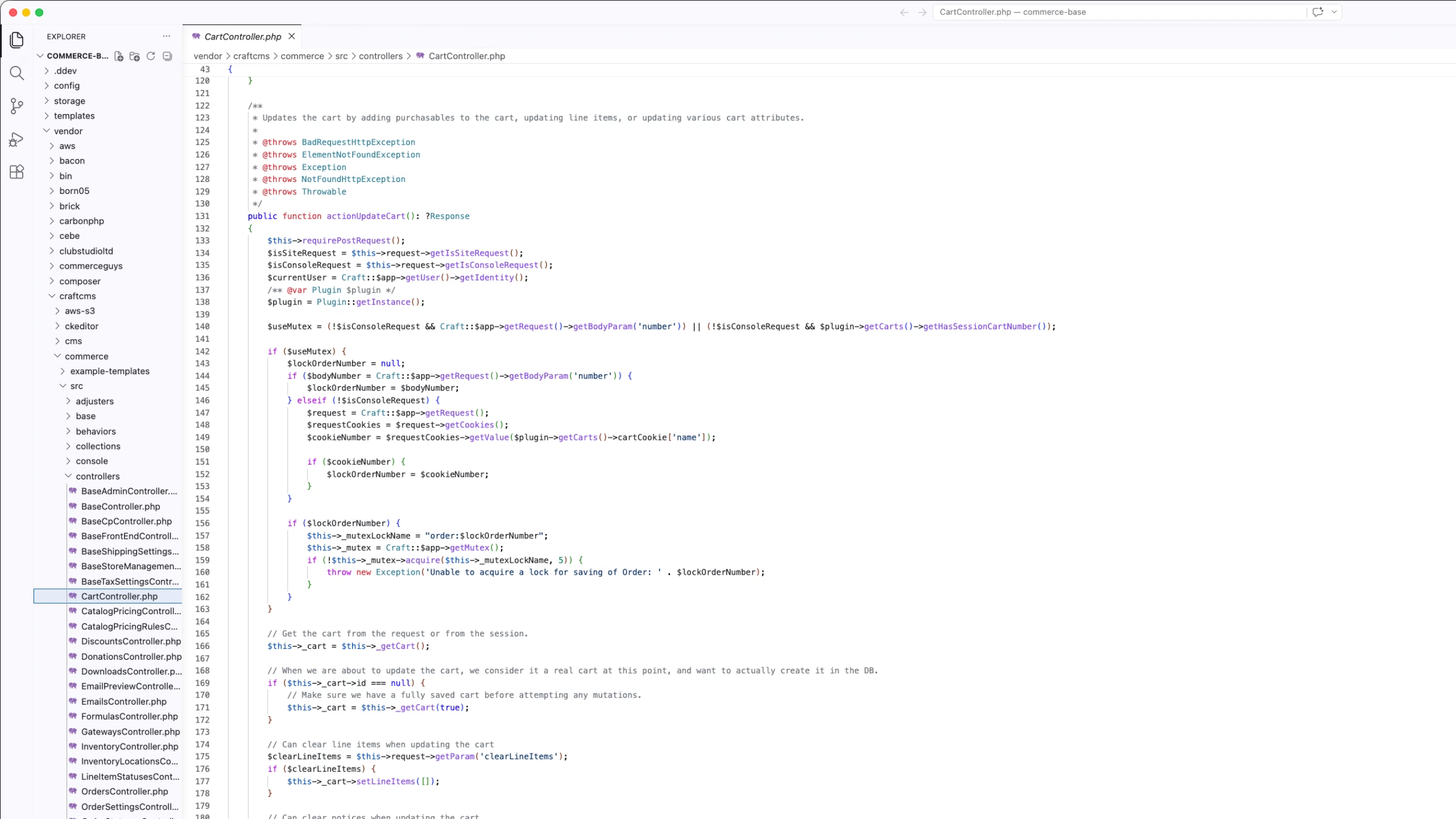
Craft Commerce is built differently. It gives you complete control over every aspect of the commerce experience—purchase flows, pricing logic, checkout UX, product modeling, and the entire frontend—without the baggage of an opinionated platform that assumes it knows your business better than you do.
We build Craft Commerce implementations for businesses whose commerce needs don't fit in standard boxes.
When Craft Commerce Is the Right Choice
Craft Commerce isn't for everyone. If you're selling 50 t-shirts with standard shipping and a Stripe checkout, Shopify will serve you well and cost less to build. We'll tell you that.
Craft Commerce earns its place when your commerce requirements are complex enough that a constrained platform creates more problems than it solves. That typically looks like one or more of these:
Custom purchase flows — Your buying process isn't browse-add-checkout. Maybe it's a multi-step configuration, a quote-to-order workflow, a B2B approval process, or a booking system with availability logic. Craft Commerce lets you build the purchase flow your business actually needs rather than forcing your business into someone else's checkout.
Complex pricing — Customer-specific pricing, volume tiers, negotiated contracts, dynamic pricing based on configuration, or pricing that varies by market. If your pricing logic has conditionals, Craft Commerce can model it natively.
Content-driven commerce — Your products aren't just SKUs with images. They're editorial content, rich media, interconnected resources, or experiences that need the same content management sophistication as the rest of your site. Craft Commerce shares Craft's content engine, so your product content is as flexible as your editorial content.
Integration-heavy operations — Your commerce platform is one node in a larger system involving ERPs, inventory management, fulfillment, CRMs, and accounting. Craft Commerce's architecture is designed for this kind of integration work. See our integration services →
What We Build
-
Custom Purchase Flows
The checkout experience is where commerce platforms either serve your business or constrain it. We build purchase flows that match your actual sales process—whether that's a streamlined single-page checkout for impulse purchases, a multi-step configurator for complex products, a request-for-quote workflow for B2B, or a subscription enrollment with trial logic.
Every element of the purchase flow is custom: cart behavior, shipping calculations, tax handling, discount and promotion logic, upsell and cross-sell presentation, and the post-purchase experience. Nothing is locked behind a platform's assumptions about how commerce should work.
-
Payment Processing
We integrate with the payment processors your business and your customers need. Stripe for most North American and European implementations. Braintree, PayPal, Square, and regional processors where the market requires them. For international commerce, that often means multiple gateways configured per region. See our international capabilities →
Payment integration goes beyond connecting an API. We implement proper error handling, retry logic, webhook processing for asynchronous payment events, PCI compliance considerations, and the fraud prevention layers that protect both you and your customers.
-
Inventory & Product Management
Product modeling in Craft Commerce is as flexible as content modeling in Craft CMS. We design product architectures that handle your catalog's actual complexity: variants with multiple option dimensions, bundled products, configurable products with dependent options, digital products and downloads, and hybrid physical-digital offerings.
Inventory management connects to your operational reality—whether that's simple stock tracking within Craft, real-time synchronization with a warehouse management system, or bidirectional inventory updates with an ERP. We build the inventory layer that matches your fulfillment operations.
-
Subscriptions & Recurring Revenue
Subscription commerce adds a time dimension to every transaction: billing cycles, trial periods, plan changes, payment method updates, failed payment recovery, cancellation flows, and the analytics to understand subscriber lifetime value and churn.
We build subscription implementations on Craft Commerce with the payment gateway handling recurring billing (typically Stripe Billing) and Craft managing the subscription lifecycle, content access, and customer experience. For businesses with complex subscription models—multiple tiers, usage-based components, annual and monthly options—the logic lives in custom modules that extend Commerce's subscription engine.
Craft Commerce FAQ
-
01
How does Craft Commerce compare to Shopify for our needs?
If your commerce requirements are straightforward—standard products, standard checkout, standard shipping—Shopify is probably the more cost-effective choice and we'll tell you that directly. Craft Commerce makes sense when you need custom purchase flows, complex pricing, deep content integration, or architectural control that Shopify's platform doesn't allow. The decision comes down to how much your commerce experience needs to differ from the default.
-
02
Can we migrate from Magento or Shopify to Craft Commerce?
Yes. We migrate product catalogs, customer accounts, order history, and—where possible—subscription data and payment gateway customer tokens. Commerce migrations are more complex than content-only migrations because of the transactional data integrity requirements. We design the cutover to minimize disruption to active sales. Learn more about migration →
-
03
What transaction volume can Craft Commerce handle?
With proper architecture, Craft Commerce handles significant transaction volume. The platform itself isn't the bottleneck—server infrastructure, caching strategy, and database optimization determine your throughput ceiling. We've built Commerce implementations that handle sustained high-volume sales events without degradation. See our scaling capabilities →
-
04
Does Craft Commerce handle tax calculations?
Craft Commerce has built-in tax calculation capabilities, and we integrate with tax automation services (TaxJar, Avalara) for businesses that need real-time tax rates across multiple jurisdictions. For international commerce with VAT requirements, we configure tax zones and rates per market.
-
05
What about PCI compliance?
Craft Commerce implementations using hosted payment forms (Stripe Elements, Braintree Hosted Fields) keep credit card data off your servers entirely, significantly reducing your PCI compliance scope. We architect payment integrations to minimize your compliance burden while maintaining a seamless checkout experience.
-
06
Can Craft Commerce work in a headless architecture?
Yes. Craft Commerce's products, carts, and checkout are all available through GraphQL, making it possible to build a completely custom frontend with React, Next.js, or any other framework while Commerce handles the backend logic. This is one of Commerce's strongest advantages over platforms like Shopify, which constrain what you can do with the checkout experience. See our headless capabilities →