Our Approach
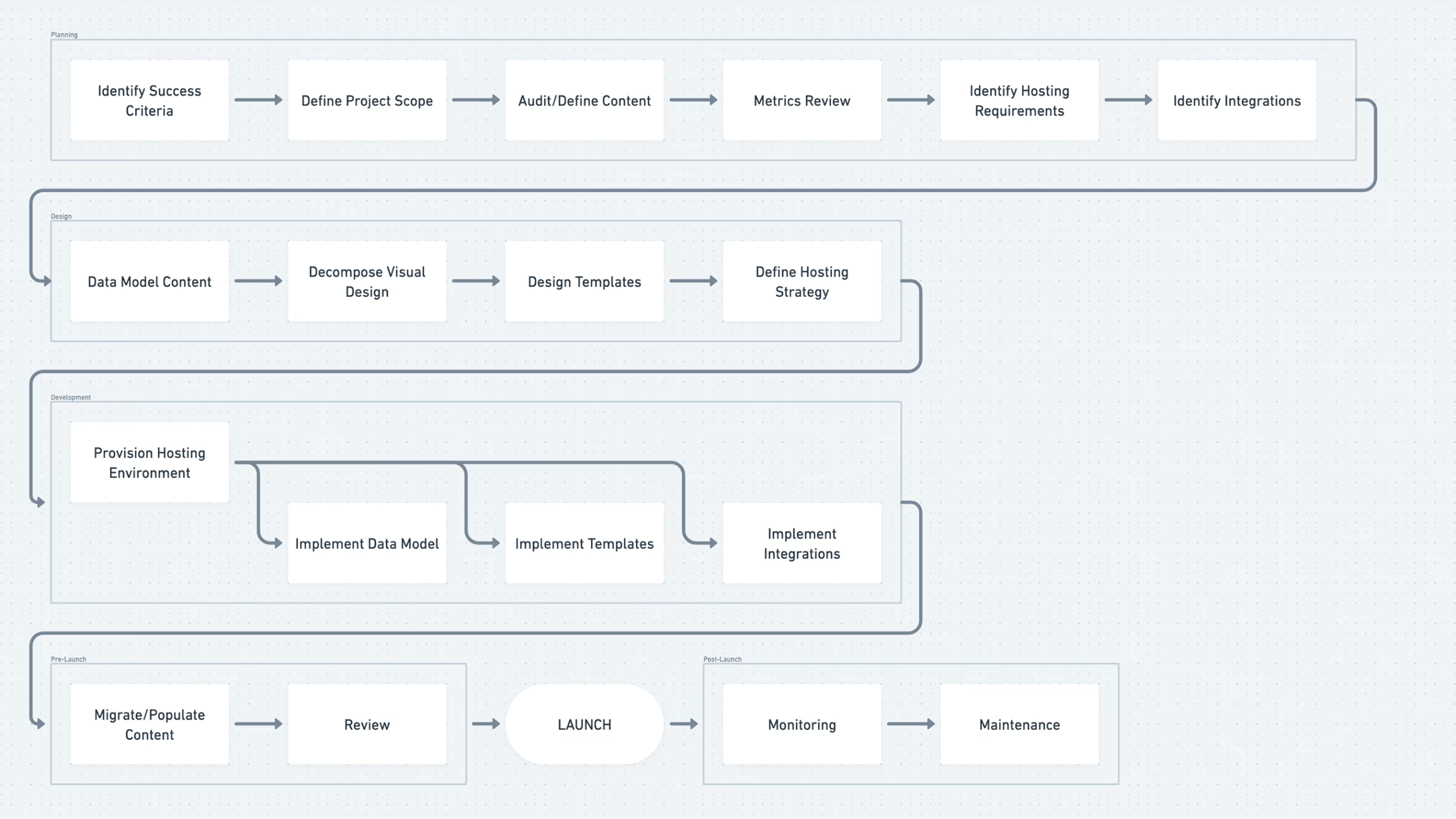
Every engagement follows the same fundamental structure, whether it's a six-week marketing site or a six-month enterprise platform. The depth and duration of each phase scales with the complexity of the project, but the sequence is consistent—because it works.
We front-load the thinking, build iteratively, optimize before launch, deploy carefully, and support what we ship. Here's how each phase works.
Step 1
Discovery
Get the Plan Right Before Writing a Line of Code
Discovery is where projects succeed or fail. We've seen enough engagements go sideways to know that the cause is almost always the same: not enough rigor in the first few weeks. Assumptions that go unchallenged. Requirements that sound clear but mean different things to different people. Technical decisions made without understanding the full picture.
We don't let that happen.
What Discovery Looks Like
Discovery starts with understanding your business goals—not your feature list, but what you're actually trying to accomplish. The feature list comes later, informed by those goals and constrained by technical reality.
We audit your existing systems when they exist. We map your content model, your integrations, your user workflows, and your infrastructure. We identify technical risks and dependencies. We talk to your content team about how they actually work, not just how the current CMS says they should work.
For new builds, we design the content architecture, define the technical stack, and plan the information architecture. For existing Craft sites, we assess the current state and identify what needs to change.
What You Get
Discovery produces a detailed technical specification—the blueprint for the entire engagement. It includes content model design, technical architecture decisions (and the reasoning behind them), integration requirements, infrastructure recommendations, a phased delivery plan, and a realistic timeline and budget.
This document is yours regardless of whether you proceed with us. It's specific enough that any competent Craft development team could execute against it.
Timeline
Typically 2-4 weeks for standard projects, 4-6 weeks for complex or enterprise engagements.
Step 2
Development
Build Iteratively, Ship Frequently
Development happens in short sprints—typically two weeks—with working software delivered at the end of each one. Not mockups, not prototypes, but functional Craft implementations that your team can review, test, and give feedback on.
How We Build
We start with the content model and backend architecture. Getting the foundation right matters more than getting pixels on screen quickly. Once the content model is solid and your editorial team can start working with real content structures, we layer on frontend implementation, custom functionality, integrations, and refinements.
Each sprint has a clear scope agreed on at the start. At the end of each sprint, you see what was built, test it in a staging environment, and give feedback that shapes the next sprint. This means you're never more than two weeks away from course-correcting if something isn't right.
What You'll See
Your team gets access to a staging environment from the first sprint. You'll see the Craft control panel with your content model, frontend templates taking shape, and integrations coming online incrementally. Feedback is most valuable when it's based on working software, not specifications—so we get you there as quickly as possible.
Your Role During Development
We need your team engaged—not full-time, but consistently. Content teams should be populating the staging site with real content as soon as the content model is ready. Stakeholders should be reviewing sprint deliverables and providing timely feedback. Decision-makers should be available for the occasional question that can't wait until the next scheduled call.
Projects stall when client feedback loops stretch from days to weeks. We'll be direct about when we need your input and why it matters.
Timeline
Varies by project scope. Typical range: 6-16 weeks of active development.
Step 3
Optimization
Fast by Design, Faster by Discipline
Before anything goes live, we run a dedicated optimization phase. This isn't an afterthought—it's a distinct project phase with its own timeline and deliverables.
What We Optimize
We profile the site under realistic conditions: real content volumes, simulated traffic, and the full integration stack active. We measure page load times, server response times, database query performance, and Core Web Vitals. Then we fix what needs fixing.
Common optimization targets include database query reduction (Craft sites with complex content models often generate more queries than necessary), template rendering efficiency, image and asset delivery strategy, cache configuration, and third-party script management.
For commerce sites, we pay particular attention to cart and checkout performance, product catalog query speed, and the additional load that inventory checks and price calculations introduce.
Load Testing
We run load tests that simulate traffic at multiples of your expected volume. If your site should handle 500 concurrent users, we test at 1,000 and 2,000 to understand where the breaking points are and how the site degrades under pressure. This reveals infrastructure limits and scaling needs before your users discover them.
What You Get
A performance baseline documented with specific metrics. Before and after comparisons for every optimization applied. Confidence that the site will perform well under real-world conditions. And recommendations for ongoing performance monitoring.
Timeline
Typically 1-3 weeks, depending on project complexity.
Step 4
Deployment
Go Live Without the Drama
Launch day should be boring. If everything before it was done right—solid architecture, tested code, validated performance, rehearsed deployment—going live is a procedural step, not a white-knuckle event.
Pre-Launch
Before we flip the switch, we run through a comprehensive launch checklist: SSL certificates configured, DNS changes planned and documented, redirects tested (especially critical for migrations), monitoring and alerting active, backup systems verified, rollback procedure documented and tested, and stakeholders aligned on the timeline.
For sites replacing an existing platform, we coordinate the cutover to minimize the transition window. For commerce sites, this includes order handling procedures during the switch and validation that payment processing is active.
The Launch
Deployment follows the same CI/CD pipeline used throughout development—no special "launch day" process that hasn't been tested. We monitor closely during and after launch, watching error rates, response times, and user behavior for anything unexpected. Your team knows exactly what's happening at every step.
Post-Launch
The first 48 hours after launch get close attention. We monitor performance under real traffic, watch for edge cases that testing didn't catch, and address any issues immediately. A brief post-launch review captures lessons learned and identifies any follow-up work.
Timeline
Launch day itself is typically a few hours. The pre-launch preparation and post-launch monitoring window spans about a week.
Step 5
Support
We Don't Disappear After Launch
Launching is a milestone, not a finish line. Your Craft site needs ongoing attention—security updates, Craft version upgrades, performance monitoring, content model refinements, new feature development, and the inevitable "can we add..." requests that come once your team starts using the platform in earnest.
What Ongoing Support Looks Like
We offer monthly retainers scaled to your needs. A basic retainer covers Craft and plugin updates, security patching, backup monitoring, and a bank of hours for small changes and fixes. More comprehensive retainers include performance monitoring, proactive optimization, feature development, and priority response times.
Every retainer includes direct access to your development team—the same people who built your site, not a rotating support desk.
Craft Updates & Upgrades
Craft releases regular updates—security patches, bug fixes, and major version upgrades. We handle these on a regular schedule, testing each update in staging before applying to production. Major version upgrades (like Craft 4 to Craft 5) are scoped as mini-projects with their own testing and validation.
Knowledge Transfer
Whether you continue with us or not, we ensure your team can operate the platform independently. This includes documentation for content management workflows, technical documentation for your development team, admin training for your content editors, and architecture decision records so future developers understand why things are built the way they are.
Timeline
Ongoing. Most clients start a support retainer immediately after launch and maintain it indefinitely. Some transition to their own team after a knowledge transfer period.
Our Approach FAQ
-
01
Can we skip discovery and go straight to development?
We strongly advise against it for any project of meaningful complexity. Discovery is where we identify risks, resolve ambiguities, and make the architectural decisions that everything else depends on. Skipping it doesn't save time—it moves the cost of those decisions into development where changes are 5-10x more expensive. For very simple projects (a straightforward marketing site with a well-defined design), we can compress discovery into a few days rather than a few weeks.
-
02
What if we've already done discovery with another team?
We'll review their work and use whatever is solid. If the technical specification is thorough and the architectural decisions are sound, we can adopt it with minimal additional discovery. If it's incomplete or we disagree with key decisions, we'll tell you where and why, and scope a targeted discovery to fill the gaps.
-
03
How involved do we need to be during the project?
More than you might expect, but less than full-time. We need timely feedback on sprint deliverables (within a few days, not a few weeks), availability for questions that arise during development, and content team engagement for populating the staging environment. Plan for a few hours per week of active involvement, with more during discovery and launch.
-
04
What happens if the project scope changes significantly mid-development?
We reassess. Significant scope changes—not small refinements, but fundamental shifts in requirements—require revisiting the technical plan and adjusting the timeline and budget accordingly. We'll present the options clearly: absorb the change with an adjusted timeline, reprioritize existing scope to make room, or defer to a future phase. What we won't do is pretend the change has no impact and deliver late.